

Another Step To Intelligent Coolant Control
Research Project with OPEN MIND
25.11.2025 — A follow up project by the Institute of Production Engineering and Machine Tools at Leibniz University Hannover (IFW) together with OPEN MIND Technologies AG has taken the idea of energy savings through demand-based coolant supply one significant step further. In collaboration with Kennametal Inc. and DMG MORI, the partners have developed a method that derives the required coolant flow directly from the material removal rate calculated in CAM planning and integrates this information into the NC code. The adaptive coolant supply programmed with hyperMILL® has achieved energy savings of approximately 82 percent.
The study focused on developing a cycle time and tool specific method for planning coolant delivery directly in the CAM system. This includes the output of an adapted NC code for milling and drilling operations. This approach has the potential to build upon the existing adaptive coolant supply technology from DMG MORI. The project covered coolant demand modeling, integration into the hyperMILL® CAM software, and validation on the DMG MORI DMU 40 eVo linear machining center.
Modeling
The coolant demand model was based on the observation that rising material removal rates typically lead to higher levels of heat and chip generation, both of which must be removed from the contact zone. This simplified assumption provides a robust and tool specific method for calculating coolant demand using standard CAM data. Reference data for each tool’s maximum material removal rate was provided by Kennametal. Pressure, flow rate, and electrical power consumption of the coolant pump were recorded, and characteristic curves were created to reflect the hydraulic conditions for each tool.
Programming
To implement the variable coolant flow along the toolpath within the CAM environment, hyperMILL®’s Python API was used. During stock removal simulation, the system analyzes the cutting parameters for each machining line and combines them with tool specific metadata to calculate the material removal rate. The IFW module then determines the corresponding coolant flow. A smoothing routine is applied before extending the NC data with the commands for flow control, which helps prevent abrupt changes.
Verification
For validation, a demonstrator part made of 11SMn30+C free cutting steel was machined on a DMG MORI DMU 40 eVo linear with milling, drilling, tapping, and broaching all applied. Instead of controlling the coolant flow line by line, the tests used an average flow per machining step, which proved to be effective. The pump’s energy consumption was recorded through the frequency converter. Compared with a conventional machining process, the adaptive method achieved energy savings of around 82 percent while maintaining the same quality of results. The CAM based solution also offers high flexibility. Users can deactivate the adaptive mode whenever the mechanical flushing effect of the coolant is required, for example during drilling. The methodology will now be further developed and researched, with the goal of making it available for additional tool types, machining processes, and materials.
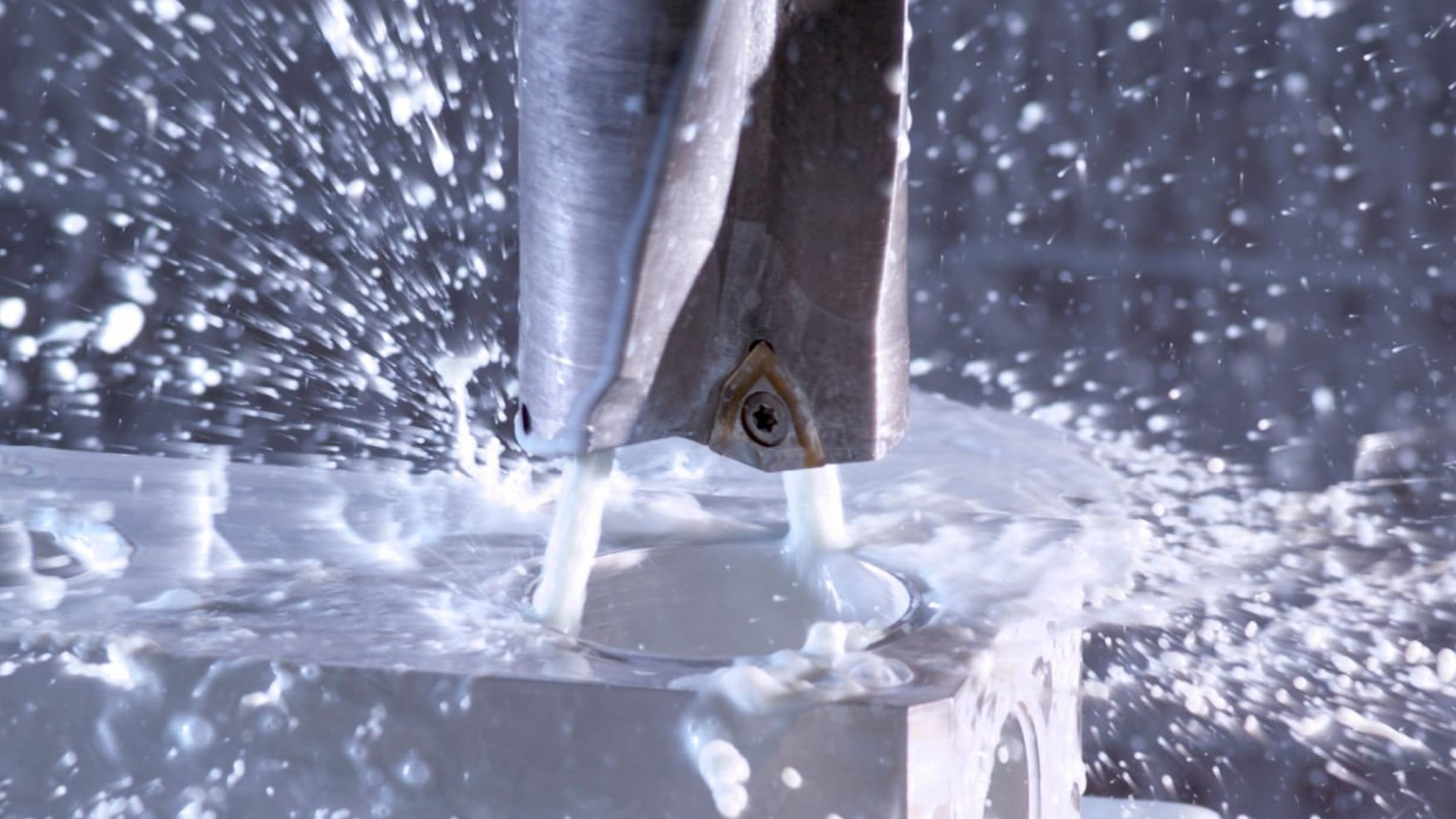
Adaptive coolant pressure control
Source: IFW
The results of the study were published by Prof. Dr. Berend Denkena, Dr. Marc André Dittrich, Dr. Klaas Maximilian Heide, Dr. Alexander Krödel Worbes, Andreas Lieber, and Talash Malek (M. Sc.). The study was also published by Martin Winkler in issue 09/2025 of the German VDI-Z journal under the title “Coolant Demand Planning Directly from the CAM System”.